
AR vs AI Virtual Try-On for Clothes: Which One Actually Works?
 TryOnAnytime
AR overlays work for glasses; apparel needs AI photo try-on for drape and fit visualization. Compare AR filters, live camera, and generative try-on—and when to use each.
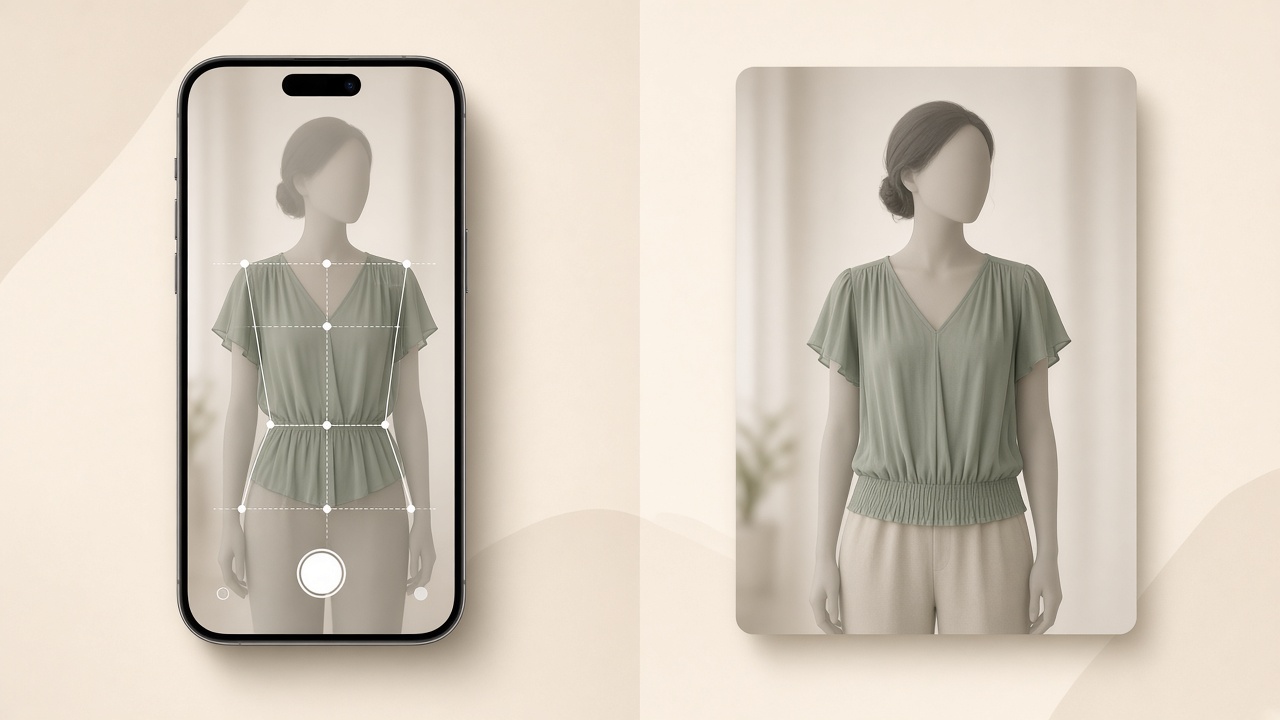
“Virtual try-on” covers two very different stacks, and the difference explains why your glasses look convincing in a filter while a dress looks like a sticker.
- AR try-on tracks your body in live video and overlays a prepared garment asset on top of it.
- AI virtual try-on (generative) redraws the scene so the garment sits on you with its own folds, shadows, and overlaps.
Same promise, opposite engineering problems. One is largely solved for rigid objects. The other is the only approach that has a chance with cloth.
Where AR genuinely wins
Rigid things with predictable anchors: glasses, watches, hats, earrings, sneakers held at a known angle. Warby Parker-style virtual mirrors work because frames are solid geometry and your face gives stable landmarks. Latency is near zero, and the result updates as you move.
For accessories, AR is not a gimmick. It answers “do these frames suit my face?” better than a photo ever will.
Why AR struggles with clothes
Cloth is not rigid. Drape depends on body shape, fabric weight, gravity, and how you stand. A body-tracked overlay has to either:
- stretch a flat product cutout across your torso — sleeves and hems turn rubbery, or
- wrap a pre-rigged 3D garment — accurate only if the brand 3D-modelled that exact SKU in that exact size.
AR also has weak occlusion and lighting reasoning: arms pass through fabric, prints do not wrap around a curve, and store lighting is not relit to match your room. That is why apparel AR demos look impressive for two seconds and unconvincing the moment you look at a hem.
Where generative AI try-on struggles
The honest list matters more than the pitch:
- Invented detail. Small logos, zips, and stitching can drift; a pattern may be re-drawn slightly differently.
- Face drift. A good model preserves you; weaker ones soften or reinterpret your features.
- Hard fabrics. Sheer material, sequins, heavy knit, and layered outfits remain failure cases.
- Pose sensitivity. Sitting, twisting, or hands over the torso degrade the result.
- Cost and latency. Seconds per image and credits per generation, instead of a free 60 fps overlay.
The mechanics are explained in how virtual try-on works; the failure catalogue is in where try-on struggles.
Side by side
- Do these frames suit my face? — AR overlay: best. AI photo try-on: acceptable.
- How does this dress drape and read? — AR overlay: weak. AI photo try-on: best available.
- See silhouette while moving — AR overlay: decent. AI photo try-on: live mode, per-frame.
- Print, colour, and texture fidelity — AR overlay: weak. AI photo try-on: decent.
- Instant feedback, no upload — AR overlay: yes. AI photo try-on: no.
- Works on an old phone or weak network — AR overlay: usually. AI photo try-on: upload required.
- Judging a specific SKU before checkout — AR overlay: poor. AI photo try-on: yes.
Which one to use, by intent
- Accessories and “does this shape flatter me?” → AR or live camera. Motion is the point.
- Apparel purchase decision → AI photo try-on, because drape and print are the questions that decide the buy.
- Comparing two colours of the same item → photo try-on, so both previews share one selfie and one light setup.
- Making content rather than deciding → a clothes-changer/generative tool, which is a different job — see what is an AI clothes changer.
A practical combination
Use AR-style live camera to sanity-check proportion and movement, then switch to a still photo for the actual yes/no on fabric, print, and length. TryOnAnytime runs both in the browser: pick Live or Photo in studio; the trade-offs are in photo vs live virtual try-on.
Neither mode measures you. Keep the size chart beside the preview and treat the result as a look check, not a fitting.
Soft CTA: run your next borderline purchase through studio — one generated still tells you more than another scroll through reviews.