
Burgundy outfits: choose the hue, the share, and the ground colour
 TryOnAnytime
Burgundy outfits built around hue and proportion: merlot, bordeaux, oxblood, maroon, and brick red compared in daylight and warm indoor light, with five colour formulas to try on.
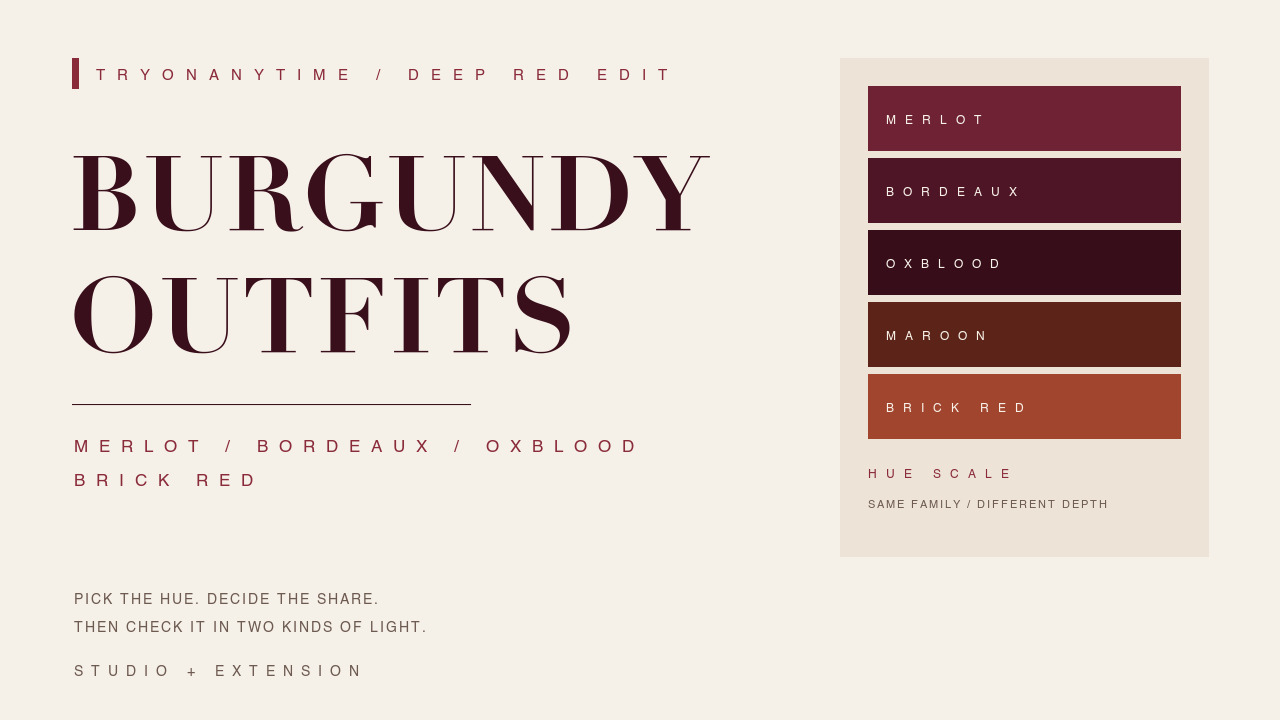
Burgundy outfits: pick the hue, decide the share, then check it in two kinds of light
A burgundy outfit is rarely a problem of missing pieces. It is one colour doing too much at once: a red cooler than expected, covering more of the frame than planned, or sitting on a ground it cannot separate from. Deep red is a narrow band, and the gap between a blue-leaning bordeaux and a warm brick red shows in a photo before it shows on a hanger.
Nor is it a list of places to wear red. It works on three decisions — hue, how much of the outfit it carries, which neutral sits underneath — plus the step that matters here: warm indoor light pushes red toward orange, daylight keeps its blue or brown visible.
Decide the hue, the share, and the ground colour
“Burgundy” covers merlot, bordeaux, oxblood, maroon, and shades a retailer may call dark red or wine. They are not interchangeable, and the label will not settle it. Decide three things:
- The hue: blue-leaning bordeaux, neutral merlot, or warm brick red.
- The share: one piece, roughly half, or a tonal run.
- The ground: black, grey, camel, cream, or denim.
| Hue | Share to control | Ground first | Check before saving |
|---|---|---|---|
| Blue-leaning bordeaux | One piece near the face | Grey, then cream | Whether it keeps depth or greys out |
| Neutral merlot | Half the outfit | Black, then denim | Where the red stops and the ground begins |
| Warm brick red | One piece low in the frame | Camel, then cream | Whether it separates from a warm neutral |
| Any hue here | Two or three tonal pieces | A lighter or deeper red | Depth and surface change |
A sequence, not a rule: what works for bordeaux may flatten brick red.
Compare merlot, bordeaux, oxblood, maroon, and brick red
Retailers use these names loosely, so treat the differences as directions. What matters: depth and temperature.
| Hue | Depth | Temperature | How it shows up |
|---|---|---|---|
| Merlot | Mid-depth | Neutral, slightly warm | A soft wine; quiet against grey and cream |
| Bordeaux | Mid to deep | Cool, blue-leaning | Blue shift beside cream; crisp edge next to black |
| Oxblood | Deep, near black | Cool to neutral | The darkest here; in low light it can lose its red |
| Maroon | Mid-depth | Warm-leaning, browner | Flatter than bordeaux; close to chocolate brown |
| Brick red | Mid-depth, brighter | Warm, orange-leaning | The warmest; shifts furthest indoors, closest to true red |
Put two on one photo rather than judging them separately. Depth is easy to compare; temperature is not, especially across different product lighting.
Decide how much of the outfit the red carries
One piece. A knit, a skirt, boots, or a bag. Placement matters more than the item: a knit near the face carries the most weight, red boots concentrate colour below, a red bag reads as a removable block. Keep the rest in one ground.
Half the outfit. A red top with a neutral bottom, or the reverse. The waistline divides two colour areas, so top length and the rise of the bottom matter as much as the shades. Deep oxblood against charcoal reads as two pieces; two mid-depth reds merge into one shape.
A tonal run. Two or three pieces from one family, which works only with a visible difference in depth or surface — a matte knit over a satin skirt, a deep coat over a lighter knit. Without it the outfit flattens into one dark mass. Area is underestimated: a coat covers more frame than any other piece, so a larger red garment means re-checking the ground and shoe.
Compare both kinds of light, then change one variable at a time
This separates deep red from pale decisions: pale outfits change through texture and shadow, deep red changes hue. Under warm indoor light the orange comes forward, cream turns warmer, and a combination reads softer than by a window. In daylight the blue or brown stays visible and edges look sharper.
Preview both on one photo with everything else held still. If the outfit only works in one, that is a lighting effect, not a colour decision.
Compare burgundy looks in Studio →
| The combination | In daylight | Under warm indoor light |
|---|---|---|
| Bordeaux next to cream | Blue shift is clear; colours stay distinct | Cream warms and contrast softens |
| Oxblood next to black | The edge holds | The red can merge into the black |
| Brick red next to camel | The warm red separates | The two warm tones move together |
Previews compare appearance, not material: dye and real sheen stay unknown.
Deep red is easy to misjudge when several things change at once, so fix a base — same trousers, boots, and light — and change one thing at a time. Swap only the red first (merlot, bordeaux, warm brick red); then hold hue and change only the surface (matte knit, satin, leather); then change only the lower half (trousers, a wide leg, a midi skirt). Save each state: after three comparisons only a saved sequence shows which variable moved the outfit.
Material and gloss change the same hue
Two garments in one red can read as two colours by how they treat light.
- Matte knit: absorbs light, so the red reads deeper and flatter.
- Satin: bright on the fold, dark in shadow, so the hue shifts across one piece.
- Leather: holds a harder highlight, which sharpens the outline.
- Velvet: a deep pile with a strong light-to-dark split; at a distance the red reads darker.
Visual only: a preview shows a surface in an image, not fibre, weight, or drape.
Five burgundy outfit formulas
Burgundy knit + grey wide-leg trousers + black boots
A neutral merlot knit against mid-grey is the quietest version of this palette. With trousers and boots fixed, compare a cooler bordeaux knit with a warmer one: the cooler red keeps more edge, the warmer one sinks toward the grey. Watch where the knit hem lands, since the grey below decides how much red shows.
Burgundy satin skirt + cream knit + camel coat
The red sits low on a reflective surface, so the hue shifts as the skirt moves. With knit and coat constant, compare a mid-depth bordeaux with a deeper oxblood: the darker red separates more clearly. Check where coat hem, skirt hem, and boots meet.
Burgundy blazer + black trousers + loafers
A structured red jacket over black is the clearest test of depth. Compare deep oxblood with mid-depth merlot and watch the shoulders: a darker red holds the outline, a lighter one softens it. Whether the blazer reads as outerwear or a top changes how much black it needs.
Burgundy coat + all-black base
The coat is the largest area of red you can wear, so the base stays simple: black trousers, a black knit, then the coat. Compare a deep coat with a lighter one. The question is where the red stops being visible: a very dark coat on black can lose its edge indoors, a mid-depth coat keeps a boundary. Check collar and knit neckline together, where the colours meet.
Burgundy denim + oat sweater + sneakers
Burgundy denim is the most casual route, where the ground carries the outfit. With sweater and sneakers fixed, compare depth rather than cut: a browner maroon denim sits close to oat, a cooler bordeaux separates from it. Keep the shoe in every full-length comparison.
Where burgundy outfits usually go wrong
A saturated ground. True red, bright orange, hot pink, and acid green compete with burgundy for the same role, so the outfit feels loud without being clear.
A cool red on a cool mid-grey. Both lose depth against each other, so the outfit looks grey rather than wrong; cream or black restores it.
Shoes and bag both claiming colour. One red accessory is a decision; red shoes plus a red bag compete for the same job. Keep one and let the other sit in the ground.
Preview real candidates with the extension
Preview items with the extension →
When a specific knit, skirt, blazer, coat, or pair of boots is in front of you, preview it on your own photo instead of judging the flat product image. Keep one saved base constant across candidates, and store the product URL beside each preview so colour direction stays tied to the description, size chart, and returns.
Here, product photography and the delivered garment can differ more than expected. Use the preview for hue direction and area; the product page answers the rest. Setup is in the virtual try-on Chrome extension guide; the wider process in how virtual try-on works.
What virtual try-on can and cannot tell you
It can compare hue direction against a specific ground, the share the red carries, where a hem or collar meets another colour, and whether two reds read as one piece or two. It can hold daylight and warm-light versions side by side.
It cannot confirm an exact colour code, a dye lot, real sheen, garment fit, sizing, warmth, weather performance, or behaviour in a room you have not photographed. Screens, devices, and indoor light change how deep red appears; previews compare direction and proportion, not a precise shade.
Keep burgundy separate from the nearby guides
The question here is hue, share, and ground inside the deep red family. For the opposite problem — pale shades separated by depth and texture — see the winter white outfits guide; for coat-first looks in any colour, the winter outfits for women guide.
Burgundy appears in many plans without making this an occasion guide. Where the brief is an event, the question changes: holiday party outfit ideas, Christmas outfit ideas, New Year's Eve outfit ideas, and Thanksgiving outfit ideas start from the event. Winter birthday outfits and date night outfit ideas follow that pattern, as do concert outfit ideas, après-ski outfit ideas, and family photo outfit ideas. Wedding-guest dress codes and job-interview outfits need their own assessment.
Save one burgundy look and one backup
Choose hue, then share, then ground; compare it in daylight and warm indoor light before committing; change one variable at a time: hue, material, then the bottom silhouette.
Save a primary look and one backup in Studio with both lighting versions attached. Compare your burgundy shortlist in Studio → For real products, return to the browser extension, preview each candidate on your own photo, then confirm colour code, fabric, and size in the product description.