
Business casual outfits for women: the weekday line between polished and too formal
 TryOnAnytime
Business casual outfits for women get clearer when you can see the weekday line between polished and too formal. Preview one garment at a time.
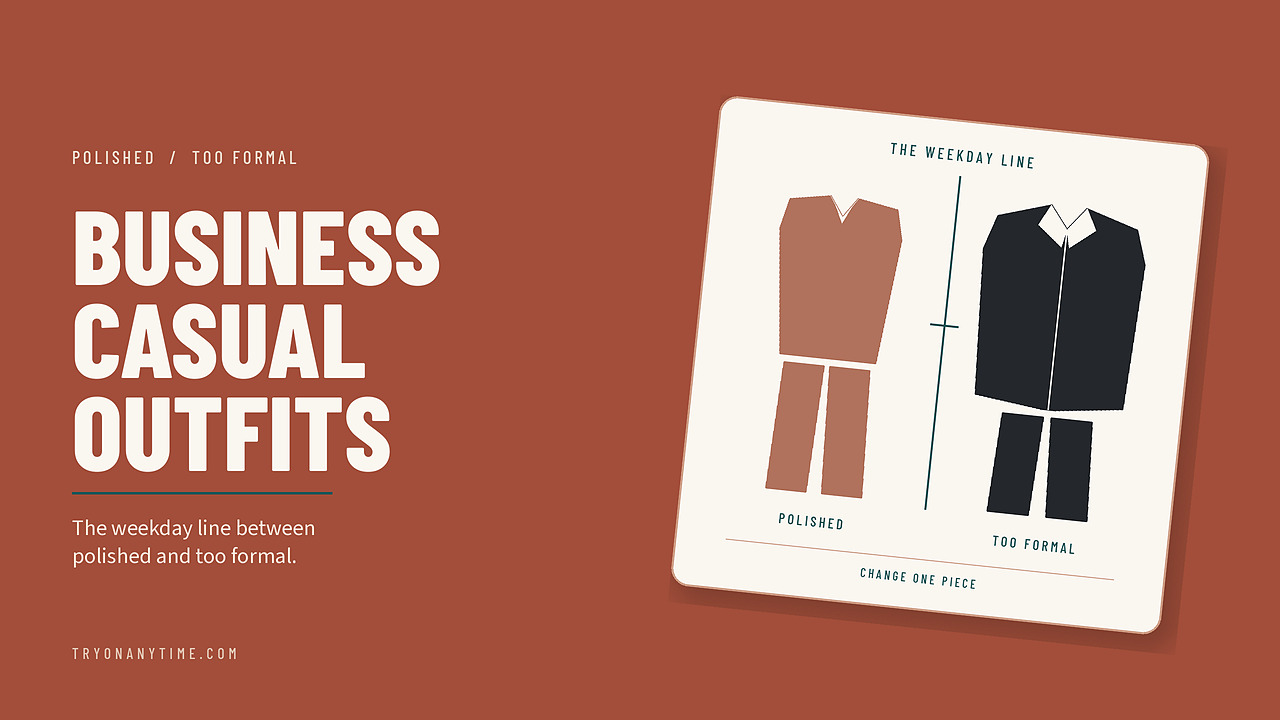
Business casual outfits for women are easy to name and harder to judge in a weekday photograph. The question is usually a line: does this look polished enough for a workday, or has it crossed into too formal, like a second interview outfit? A third read sits on the other side of that line: too loose, and it no longer looks like work. Those reads are easier to separate when you change only one garment at a time.
This page stays on that weekday line. It is not a guide to interview dress, and it is not a guide to an office holiday party. If you are dressing for an interview, use the job interview try-on guide. If the next event is a holiday party at the office, that belongs on the holiday party outfit page.
A try-on can help with part of this, and only as a picture. In Studio or the browser extension, you preview one garment on a photograph of yourself, or on a live camera view. The public Studio guide is direct: the result is a visual preview, not a measurement or a sizing promise. Light, pose, fabric, and anything covering the body can change what you see. The preview cannot verify that a jacket, a knit, and trousers will go on together. A render that looks puffy, tight, or stacked at the shoulders is still only a picture, not a reading of thickness, drape, or how the clothes will move. It also cannot tell you whether a workplace will accept the outfit. Shoes in the examples below help you see a hem; the try-on is for clothes, not for footwear. Colour names and size stay with the seller's description, and with a size chart when the shop provides one.
Name the weekday line first
Write the three reads down before you change anything.
Polished. The photograph still looks like a workday. The clothes look put-together, but they do not look like a second interview outfit.
Too formal. The same photograph starts to look like a second interview outfit — a jacket and trousers that read as a suit, or a dress that looks chosen for a formal meeting rather than a Tuesday at the desk.
Too loose, and it no longer looks like work. The clothes may be comfortable, but the photograph no longer says you are heading to the office.
A still can help you see which read the outfit is giving. It cannot confirm a company's dress code; that rule lives with the workplace.
Do the check by holding the rest of the outfit still and changing only one piece. When a jacket goes over clothes you already have, put the pieces on and look at them in a photograph.
See the line by changing one garment
Start from a weekday outfit and name the read in a full-length photograph: polished, too formal, or too loose. Then change only the piece you think is moving that read.
If that piece is already in your closet, wear it with the rest of the outfit you already have, take a full-length photograph, and look at whether the read has changed. If a jacket is on, notice whether it has pulled the whole look toward too formal.
If the piece is still a candidate, preview that one product image on a full-length photograph of yourself, in an inner layer you already wear, and keep the trousers or skirt the same. Do not ask the preview to place a candidate jacket over a candidate knit as if the two had been photographed together. Photo try-on is built around one person image and one garment image, not a precise composite of several layers.
When you compare two candidates for the same role — two jackets, or a knit and a blouse — preview each product image on its own, on the same photo. A preview can still shift from one render to the next, so do not treat every difference on screen as a fact about the garment alone.
Compare one weekday piece in Studio →
Use one full-length photograph and preview one real product at a time. If you are deciding whether a jacket pushes the look too formal, compare two actual jackets on that same photo and leave the knit and trousers as they are. If you are deciding whether the trousers still look like work, compare two actual pairs and leave the top alone.
Look for things a still can show: whether the piece you are testing makes the outfit look polished, too formal, or too loose; where a hem or a cuff lands; and whether the weekday read you named still holds. This is a comparison of two real products, not a way to recolour a single garment in an editor. Use a product photograph that shows the whole garment; a crop that cuts off the hem leaves the preview to guess where it ends.
If you want to know what a jacket, a knit, and trousers look like together, wear them and take a photograph. Because you put them on, you already know they went on that day. That is still not a size guarantee, and it does not tell you how the clothes will feel when you reach, sit, or walk — try those movements with the clothes on. You can still preview the jacket or the knit by itself; that tells you about that one piece.
In colder months, a weekday office outfit often adds a coat or a heavier knit, and that layer can push a polished look toward too formal. Check the coat or the knit on its own, on a photograph that already looks like a workday. For a wider winter method, see the winter outfits for women guide. This page stays on the weekday line, not on winter dressing as a whole.
Three outfits, one change each
The three sets below each change one thing, so the line stays easy to see. None of them is a promise that a colour or a hem will slim you, and none of them is a workplace rule.
Knit and trousers, then one jacket
Wear a fine knit with tailored trousers — a familiar weekday office outfit. Look at whether the photograph already looks polished, or too loose. Then, on the same photograph and the same trousers, preview one jacket. A soft cardigan or an unstructured jacket may keep the look polished. A sharply cut blazer, worn as if it were half of a suit, may tip the same base into too formal. Compare two actual jackets, one at a time. Do not also change the trousers in the same step. Leave the shoes as they are.
Trousers or a skirt, with the top held still
Hold the knit or shirt still. On the same photograph, compare straight trousers with a wider pair, or trousers with a midi skirt. You are asking whether the bottom still looks like a weekday in the office, whether it has become too loose, or whether a very sharp trouser has made the whole look too formal. Leave the shoes as they are; the try-on is for clothes, not for footwear. Loafers or ankle boots in a full-length still can help you see a hem.
A dress, then one layer over it
Try a weekday dress on its own. Ask the same question: polished, too formal, or too loose. Then preview one layer — a cardigan, or a jacket — on a photograph of that dress, or wear a layer you already own and take a new photograph. If both are still candidates, do not ask the preview to place them as if they had been worn together. Look at where the dress hem lands, and whether the added layer pulls the read toward too formal.
Easy mistakes when you read a preview
Changing the jacket and the trousers at the same time. If you switch jackets and also change the trousers, you will not know which change moved the read. Hold one piece still.
Generating more than one layer in succession. Shoulder seams may land on top of each other in the frame. Stop and use clothes you can put on, rather than treating the overlap as proof that the jacket will not go over the knit.
Reading a puffy or tight render as a fit decision. A preview can make a jacket look inflated over a knit, or close against the body. That is still only a picture, not a measurement, and not a reading of how soft or firm the fabric is.
Using this page as an interview shortlist. If the next appointment is an interview, leave this weekday method and use the job interview try-on guide.
What a preview can show, and what it cannot
A single-garment preview on a full-length photo can be a useful check of colour and proportion, sleeve length, and where a hem lands. Two product images on the same photo make that comparison cleaner than hanger shots alone, even though the render can still vary. The preview will not confirm a colour code, a size, a fabric hand, or that several pieces go on together, and it will not confirm a dress code. Use the preview to choose a direction. Use the seller's notes, a size chart when the shop provides one, and the clothes themselves to answer the rest. Use the workplace itself for the rule.
Read the product page while you preview the garment
When you have two candidates for the same role, open each product page and preview the garment there, so you can go back to the colour name, length notes, fabric notes, or size chart the seller actually provides, when those are on the page. Not every shop publishes a size chart, and those fields will not always sit beside the preview.
Preview the garment on the product page →
The Chrome extension is built for that moment: you stay on the shop's page and can look back at the listing while you preview the piece. A product photograph taken on a table or a hanger can make a jacket or a knit look shorter or more structured than it will on a body; the description will not settle the look, but it will tell you how the seller describes colour, length, and material. Confirm the colour name, fibre content, and stated length against that text, and against the piece in hand if you already have it.
If you want a record of a comparison, keep a screenshot yourself. That is your own file, not a built-in save feature in the product.
If the next question is a different day
Once the weekday line is in a range you like, you may still have a different occasion to dress for. Interview dressing is in the job interview try-on guide. An office holiday party belongs on holiday party outfit ideas.
The limits of a preview are in how virtual try-on works. To preview on the pages you already browse, see the Chrome extension guide.
Keep the line in view
Name the read in the photograph: polished, too formal, or too loose. Do the check by changing only one garment. When a jacket is in the look, put the pieces on, take a photograph, and try a few movements.
Compare one weekday piece in Studio → Use the stills to choose a direction. Then, in the browser extension, read the same garments against the listing — the colour name, length notes, fabric notes, or size chart the seller provides, when those fields are there.