
How to style wide leg jeans: hem, rise, and tuck in proportion
 TryOnAnytime
How to style wide leg jeans by fixing four variables — hem length, shoe, top length, and tuck — with a hem-to-shoe comparison, five structural outfits, and three outerwear lengths.
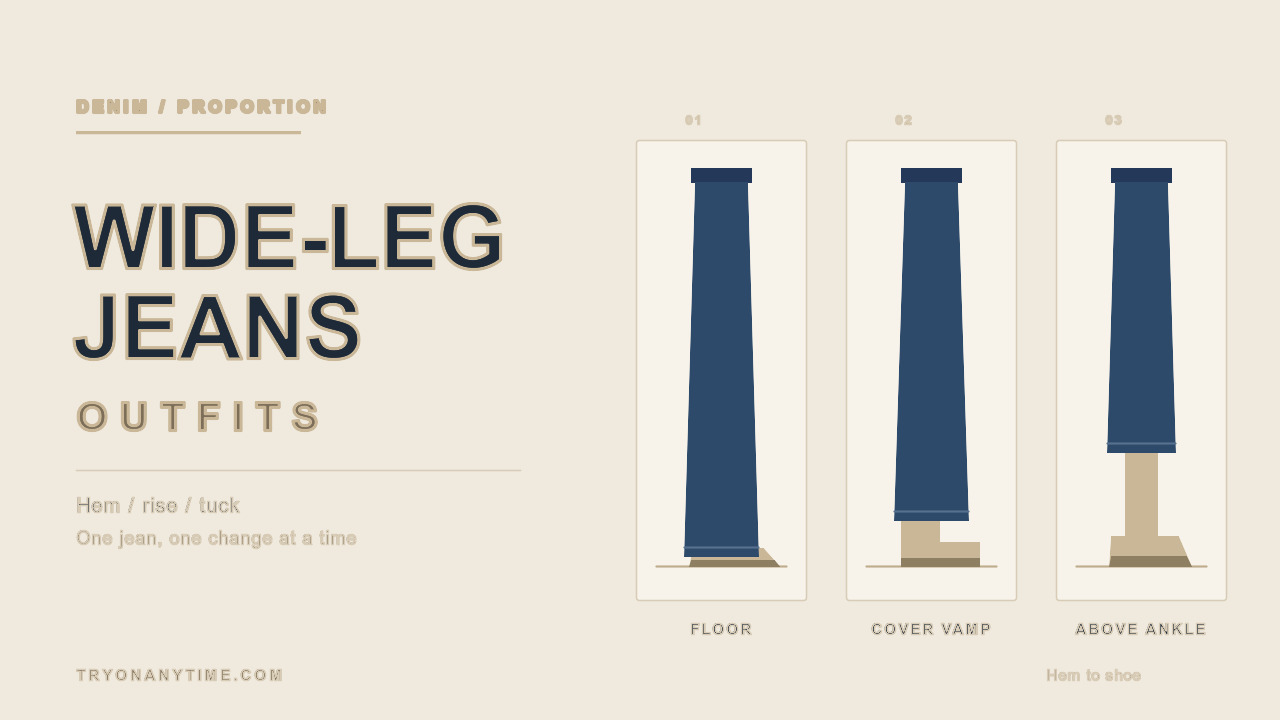
How to style wide leg jeans: set the hem, the rise, and the tuck first
Wide leg jeans are rarely a shopping problem. The pair is usually already in the wardrobe, and the question is why one combination looks composed while another looks borrowed. The answer is almost never the wash or the price. It is where the hem stops on the shoe, where the waistband sits, how long the top is, and whether that top is tucked.
Treat this as four variables and an order, not a list of wide leg jeans outfits to copy: fix the denim, change one thing, look, save.
Set four axes before comparing anything
Give each axis one value at a time, and write the four down.
- Hem length: floor-grazing (it covers the shoe and reaches the ground behind it), covering the vamp, or cropped above the ankle.
- Shoe: pointed ankle boot, flat (ballet, loafer, or a low-profile sneaker), or a chunky sneaker on a thick sole.
- Top length: cropped at the waist, ending at the hip bone, or past the hip.
- Tuck: fully tucked, half tucked at the front, or untucked.
A wide leg is a large lower volume. Everything above it competes for the same space, so the axes are not independent: changing the shoe changes which hem length reads as finished, and changing the tuck moves the waist. Advice on how to style wide leg jeans for women often becomes a list of tops; the real constraint is this geometry.
Compare four hem landings against the shoe
Look only at the meeting point: the same jean reads differently depending on whether it covers the vamp, touches it, clears the ankle, or piles on the shoe.
| Hem landing | Shoes that suit it | Steadier when | Watch for |
|---|---|---|---|
| Covers the vamp (including floor-grazing) | Pointed ankle boot, block-heel boot, a flat with a defined toe | The toe still shows; the hem clears the ground at the back | A hem that drags, frays, or hides the whole foot |
| Just touches the vamp | Ankle boot, loafer, ballet flat, low sneaker | The hem line stays horizontal instead of curving | A single centimetre of difference flipping it into a full break |
| Cropped above the ankle | Ballet flat, loafer, chunky sneaker, short boot | The ankle is genuinely visible, not just above the shoe collar | A crop that lands mid-calf and cuts the leg |
| Pools on the shoe | Chunky sneaker, heavy boot with a wide shaft | Shallow and even, with a sole thick enough to carry it | Fabric collecting at one spot; reads as a hem that does not fit |
Floor-grazing and covering the vamp are one decision with different margins; cropped and cropped-too-high are not. A shoe change can move a hem off the vamp or off the ankle, and a shallow, even pool can be tried over a thick sole; a deep or lopsided pool is still a length problem.
Before changing the outfit, fix the frame. Work from one full-length photo of yourself in the same pair of wide leg jeans, and move through the list in order: hem, shoe, top length, tuck, coat length. Two changes at once cannot be credited to either.
Compare wide-leg jean proportions in Studio →
Let the top length and the tuck move the waistline
A wide leg jean already sets a strong vertical column; the top decides where that column starts.
Cropped top with a high rise. The waistband stays visible and the leg reads longer from the waist down. Compare a top that ends at the waistband with one two centimetres lower: the second starts eating the rise.
Long top past the hip, half tucked. Pushing the front hem in and leaving the back out puts a diagonal at the waist. It keeps the length of the top while restoring a waist point. Compare a centre half tuck with a side one; they place the waist differently.
Loose top, no tuck. Workable when the top ends above the widest part of the hip, or when the fabric is thin enough to fall close. Untucked and long over a wide leg flattens the silhouette, because two large shapes sit on each other with no waist between them.
The same length question appears with a skirt or a dress, but there the hem is the variable rather than the waistband. This page stays on denim: a fixed waistband above a wide leg is what makes the tuck matter.
Five structural outfits, one variable each
Each is a structure — a top, the jean, a shoe, and one outer layer — not a colour scheme. Collect wide leg jeans outfit ideas this way: structures to test, not pictures to reproduce.
Fine knit + pointed ankle boot + short jacket
A fine-gauge knit keeps the upper volume low so the wide leg carries the width, and a pointed boot continues the line past the hem. With the jean and boot fixed, compare a knit that ends at the waistband with one that ends at the hip: the shorter one shows the rise, the longer one covers it. Add the jacket last and check that its hem does not land where the knit hem does.
Loose shirt, half tucked + ballet flat + past-hip coat
The shirt supplies the volume, so tuck it before judging the length. With the shirt and flat fixed, compare the hem covering the vamp with a cleaner break: a flat shows less toe than a boot, so the jean needs to end slightly higher to keep the foot visible. The past-hip coat then has to clear the shirt hem by a visible margin, or the two hems merge at the thigh.
Turtleneck base layer + chunky sneaker + short puffer
A high neckline plus a thick sole pulls the eye to both ends. With the sneaker fixed, compare the hem covering the vamp against a slight pool on the sole: a chunky shoe can carry one break, not three. Then add the puffer and check where it ends — one that stops at the widest part of the jean adds width exactly there.
Blazer + loafers + long coat
The blazer is the one top here with a built shoulder, so it changes the upper outline more than its length does. Compare it open and closed over the same jean with the loafer fixed. With the long coat on, check that coat, blazer, and jean hems sit at three different heights; if two line up, the outfit reads shorter than it is.
Cardigan + ankle boot + scarf
An open cardigan creates two vertical edges either side of the body, a different problem from a closed knit. Compare it buttoned and open, then add the scarf, which changes the neckline rather than the body length — so it comes last: if the outfit already works, the scarf should not be what rescues it.
Change the outer layer length, not the base
Winter adds one more object, and this is where winter outfits built around wide-leg jeans tend to fall apart. Hold the base fixed — fine knit, same jean, same ankle boot — and try three coat lengths.
Short, ending at or just below the waist. The coat hem sits at or just below the waist, so most of the leg is visible and the coat's volume sits above the jean's. Check that it does not end exactly at the waistband, where it would look like a separate top.
Past the hip. A middle length: it covers the widest part of the hip while leaving the thigh and hem visible, so it usually needs less adjustment. Compare where the coat hem sits against the top hem and the widest part of the hip.
Past the knee. The coat now dominates the frame and only the lower leg reads as denim. Compare it with the same base and no coat: if the outfit only works with the coat on, the base needs a shorter top or a clearer tuck rather than a different coat.
If you are petite, the same three lengths apply with less tolerance: a past-knee coat over a wide leg leaves very little visible leg, so compare a cropped hem or a shorter top to keep the visible denim and upper-body proportion clear.
Preview items with the extension →
Use it on a real product page: preview the candidate jean, then the shoe, then the coat on your own photo, and keep the product link beside each preview so the description, inseam, and size chart can be checked against it later.
Where wide leg jeans usually go wrong
The hem pools on the shoe. A shallow, even pool can be tried with a thicker sole first; fabric gathered at one point reads as a length problem rather than a style choice, and there the hem has to come up. Changing the top will not fix it.
The top is long enough to erase the waist. A high rise only exists if something shows it. An untucked top past the hip turns a wide leg into a straight column and loses the difference between waist and hem.
Both halves are wide. A wide top over a wide leg removes the narrow point in the middle, and the body reads as one rectangle. Either the top gets shorter, gets tucked, or the outer layer supplies the vertical line.
What virtual try-on can and cannot tell you
It can show whether a hem covers the vamp or clears the ankle, where a waistband sits once a top is tucked, how a coat hem divides the leg, and whether the volumes above and below stay separate.
It cannot tell you the actual inseam of a pair you have not measured, how the fabric drapes as you walk, whether the rise fits your body, or how the hem moves. Pose, camera height, and heel height all change the proportion you see: the same jean shot from waist level and from chest level gives two different leg lengths, and a two-centimetre heel moves the hem line. Previews are for comparing direction and proportion, not for predicting a measurement.
Keep this separate from the nearby guides
This page is about one garment's structure: hem, rise, tuck, top length, outer layer. For winter dressing that starts from the coat rather than the trouser, the winter outfits for women guide covers that order. For pale shades rather than denim proportions, the winter white outfits guide works on a light palette; for a deep red palette, burgundy outfits handles hue and area — the wide leg there is a trouser, not a jean.
The method behind the comparison is in how virtual try-on works, and the setup for previewing a product page is in the Chrome extension guide.
Save one primary and one backup
Decide the hem first, then the shoe, the top length, the tuck, and the coat.
Save a primary and one backup in Studio with the hem, top, and coat versions attached. Compare your wide-leg jean shortlist in Studio → Use the previews to choose a direction and a proportion. Then, in the browser extension, check the same candidates against the product page's actual inseam, fabric description, and size chart before you buy; those are the parts an image cannot answer.